Idea evaluation software. Score every idea the same way, test what evidence can’t settle, then decide
Validate turns a long list into a short one you can defend. Every idea is scored on the same rubric with the evidence behind each score, experiments settle what the evidence cannot, and a person decides, with the reason written down.
Early access is by invitation.
Score the batch
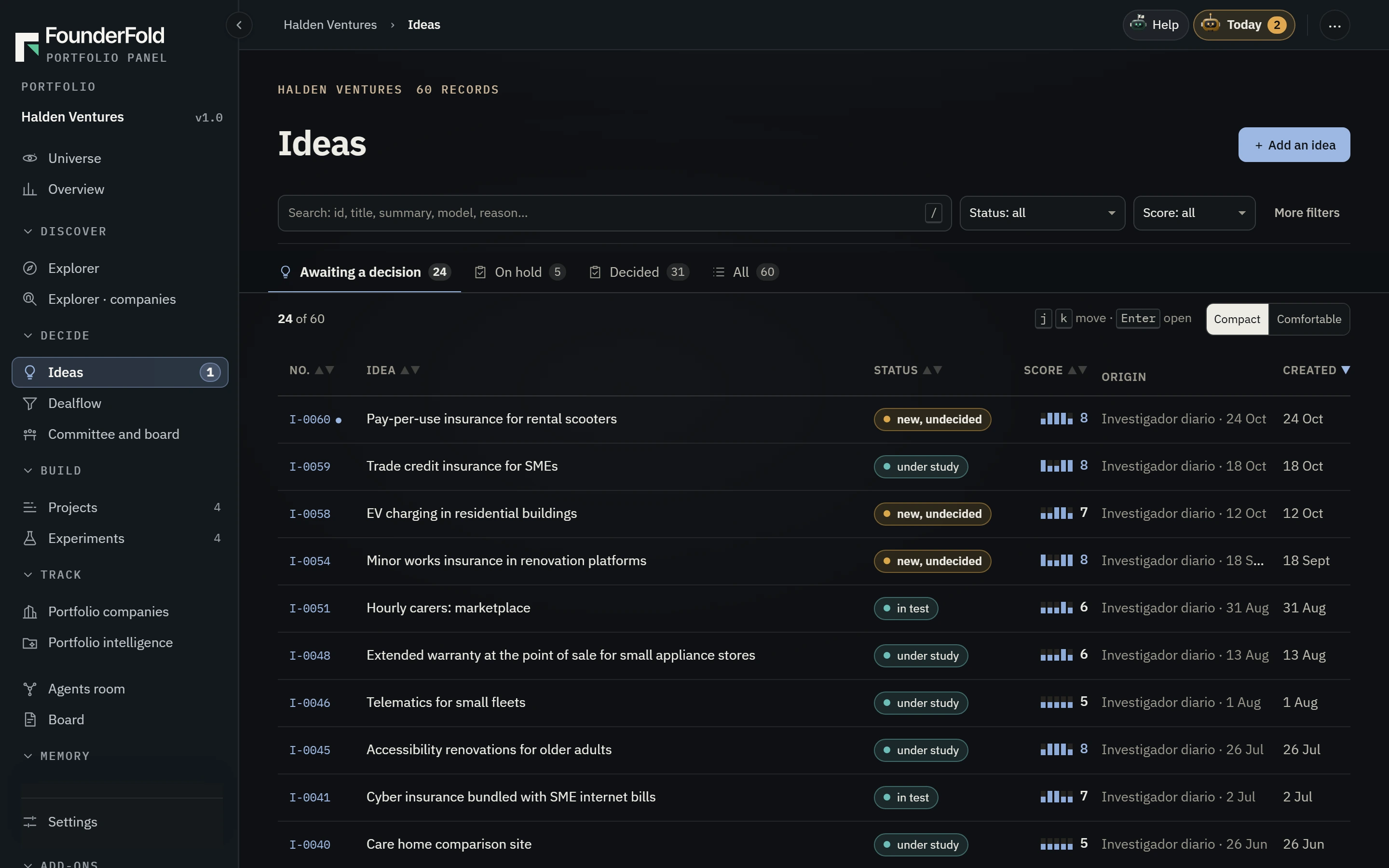
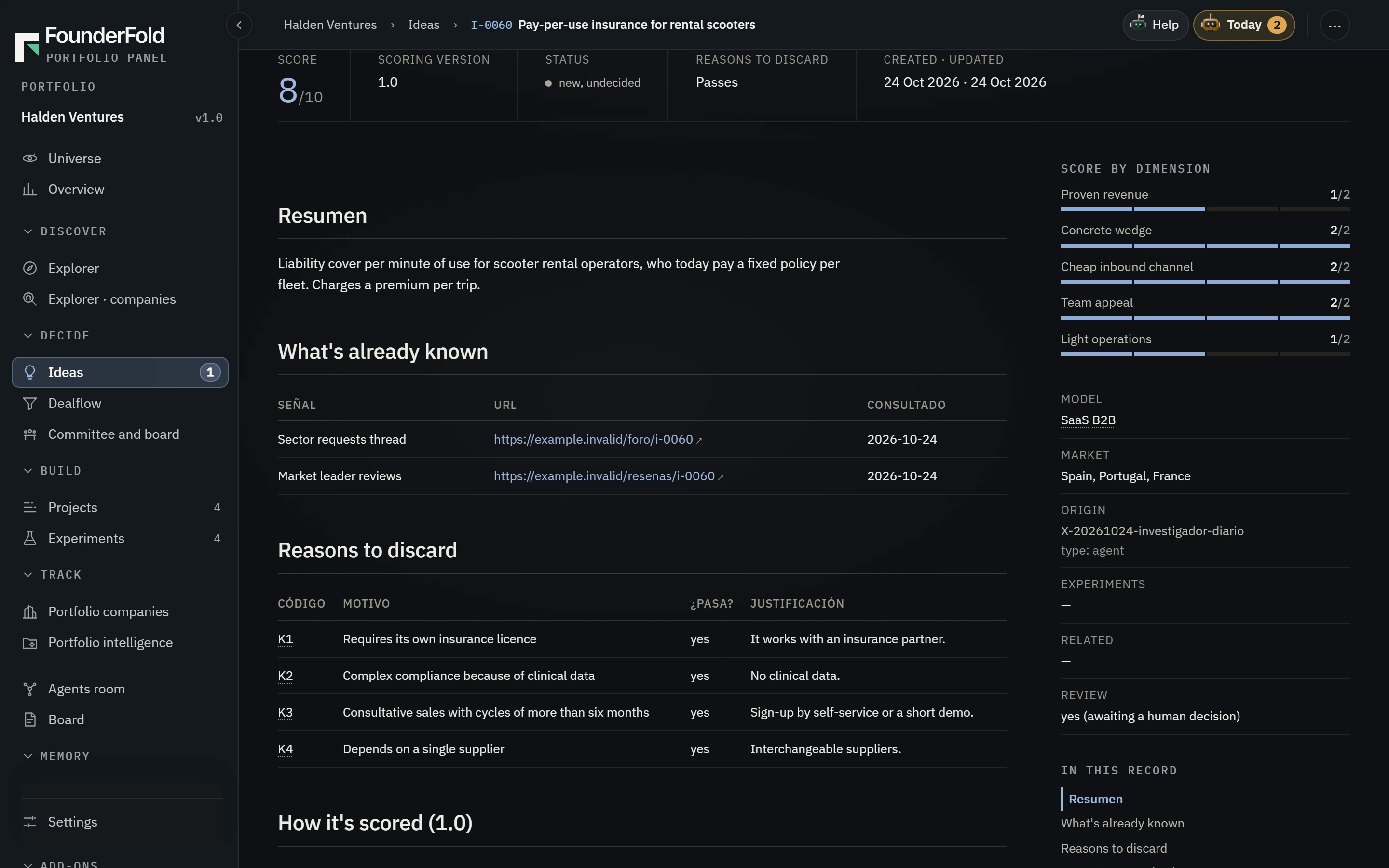
Discard with a reason
Test what is left
Illustrative data — Fictional company, ideas and figures, shown for illustration only.
Experiment E-0131 on idea I-0412: the hypothesis, the metric “paid pilots signed”, the success criterion “at least 5 of 20 clinics” and a 45-day deadline.
Choose
Illustrative data — Fictional company, ideas and figures, shown for illustration only.
“Decide on the idea” on idea I-0398 with four options; “Put it on hold” is selected with its condition and a review date in 90 days, next to a CEO proposal labeled “AI-generated” and the summary of what will be saved.
What does FounderFold do in Validate?
In Validate, FounderFold scores each idea with your portfolio’s rubric, from 0 to 2 per dimension, and saves the evidence for each score, with its link and date, in the idea’s record. Experiments test the assumptions evidence cannot settle, with a numeric success criterion and a deadline set before they start. A person then studies the idea in depth, puts it on hold, discards it or chooses it.
What you use in Validate
- Scoring version
One rubric for every idea
Your portfolio’s rubric scores each dimension from 0 to 2, and a dimension without evidence scores 0. The rubric has a version, so you always know which ideas were scored with which.
- Study it in depth
Study it in depth
The CEO studies the idea against the rubric and saves a score per dimension in its record, each with its evidence, link and the date it was consulted. You see what was checked and what was not.
- Experiments
Experiments
Write the hypothesis, the metric, the numeric success criterion and the deadline before you start. When the experiment closes, you record the result and the verdict, and the lesson stays in the portfolio.
- Decide on the idea
Decide on the idea
Study it in depth, put it on hold with a review date, discard it with the reason to discard that applied, or choose it. The CEO can propose the decision, marked as AI-generated; a person confirms it.
- Possible value
Possible value
Give an idea or a project its possible value, low, central and high, with each assumption declared, so the portfolio is valued as a range instead of a single number.
- Evaluation stages
Evaluation stages
For programs and funds that receive ideas from third parties, each one moves through evaluation stages: screening, first analysis, due diligence, committee and close. With third-party deals, the agents return points to check and a score against your own thesis; they never say whether to invest. It is not investment advice.
Twenty opportunities, two survivors
Illustrative data — Fictional company, ideas and figures, shown for illustration only.
Studio Larkspan, a fictional venture studio, reviews its quarterly batch.
Score the batch
All twenty opportunities are scored with version 2.1 of the studio’s rubric. Six fall on evidence alone, because a dimension without a source scores 0.
Discard with a reason
Sixteen are discarded, each with the reason that applied: crowded market, consultative sale, small market. The funnel shows where most of them stop.
Test what is left
Four ideas get an experiment: a landing page with a waiting list, a price test and two paid pilots. Each has its criterion, such as 40 sign-ups in 21 days.
Choose
Two experiments meet their criterion and the partners choose those two ideas. The other two are put on hold with a review date.
How to write an experiment that settles something
An experiment only settles a question if everyone agreed, before it started, what result would count. In FounderFold it is written down in four parts before it opens.
One hypothesis that can be false
A single sentence: “Clinic owners will pay €49 a month for automatic appointment reminders.” If no result could prove it wrong, it is not ready to test.
One metric, with its source
The number that answers the hypothesis and where it will come from: paid sign-ups on the pricing page, not visits or likes.
A numeric success criterion
The threshold that counts as success, fixed before the first result arrives: 40 sign-ups, a 10% conversion rate, three signed pilots.
A closing date
The day the experiment ends, whatever the figures say. You record the result and the verdict, and the lesson stays in the portfolio for the next idea that tests something similar.
The CEO proposes. A person decides.
Every change of status is a person’s decision, kept in the idea’s history with who, when and why. A proposal written by the CEO is marked as AI-generated until someone confirms it.
Who Validate is for
FAQ
Keep exploring
How is an idea scored?
With your portfolio’s rubric: each dimension from 0 to 2, and 0 when there is no evidence. The score per dimension and its evidence, with link and date, are saved in the idea’s record.
What makes an experiment valid?
A hypothesis, a metric, a numeric success criterion and a deadline written before it starts. When it closes, the result is recorded against that criterion, not against what the team hoped for.
Can the AI discard an idea?
No. The CEO can propose a decision, marked as AI-generated. Discarding, putting on hold or choosing an idea is always a person’s decision, with the reason in the history.
Does it handle ideas from third parties, such as applications or deals?
Yes. Ideas from third parties move through evaluation stages, from screening and first analysis to due diligence, committee and close, with the same rubric and the same record. With third-party deals, the agents return points to check and a score against your own thesis; they never say whether to invest. It is not investment advice.
Make the next decision with the evidence on the table.
Early access is by invitation.