Stage-gate software. Take each new business through its gates, with kill criteria written before launch

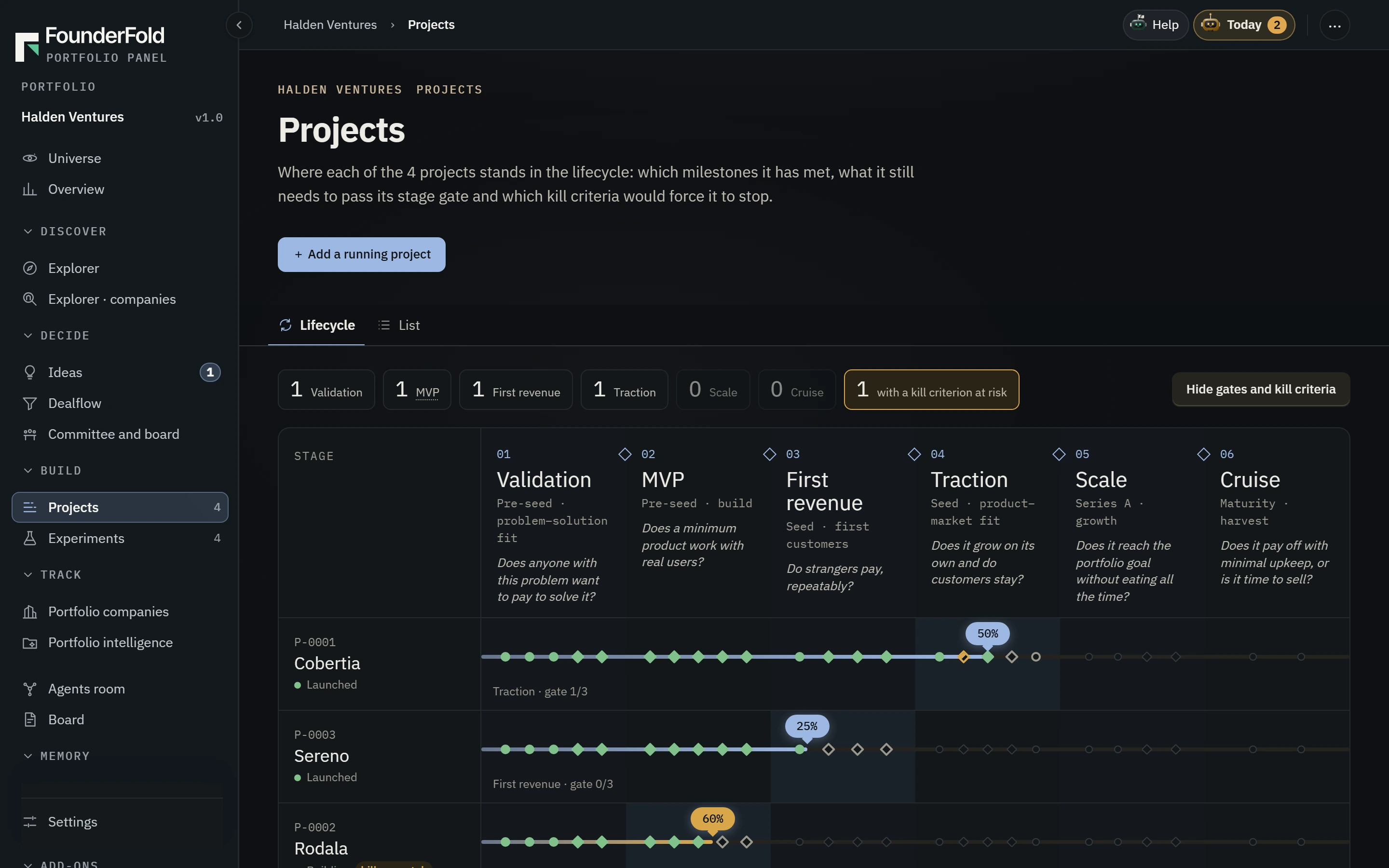
Build is where a chosen idea becomes a business. Each project runs on a lifecycle for its type of business, passes gates a person decides, and is measured against kill criteria written before anyone fell in love with it.

Request access

Early access is by invitation.

Open the Validation stage

Open the Validation stage
The project starts with three milestones: 20 clinic interviews, a price agreed with 5 clinics and a paid pilot signed. Illustrative data — Fictional company, ideas and figures, shown for illustration only.

Write the kill criterion first

Write the kill criterion first
If fewer than 5 of 20 clinics agree to a paid pilot by day 45, the project stops or pivots. Illustrative data — Fictional company, ideas and figures, shown for illustration only.

Record the figures

Record the figures
Each week the founder records interviews and pilots. On day 30 the criterion shows Watch, with 3 pilots so far. Illustrative data — Fictional company, ideas and figures, shown for illustration only.

Decide the gate

Illustrative data — Fictional company, ideas and figures, shown for illustration only.

Key figures of project P-0214: 6 paid pilots and 20 interviews recorded this week, and the kill criterion of the Validation stage changing from Watch to No risk.

The figures you record measure milestones and kill criteria. Illustrative data.

What does FounderFold do in Build?

In Build, FounderFold turns a chosen idea into a project with stages, milestones and gates from a reference lifecycle for its type of business, or with stages of your own. The figures you record measure milestones and kill criteria: No risk, Watch or Triggered. A person decides each gate, with the date and the reason, and can pause or close the project with a retrospective.

What you use in Build

  • Turn it into a project

    Turn it into a project

    A chosen idea becomes a project in its first stage, linked to the idea and its evidence. The CEO then suggests the first step in Today.

  • Stages

    A lifecycle for each type of business

    Reference lifecycles for software, a new line inside an existing company, the search for and purchase of a company, services, commerce and physical products, or stages of your own for the portfolio, with their thresholds and deadlines.

  • Gate

    Gates with a person, a date and a reason

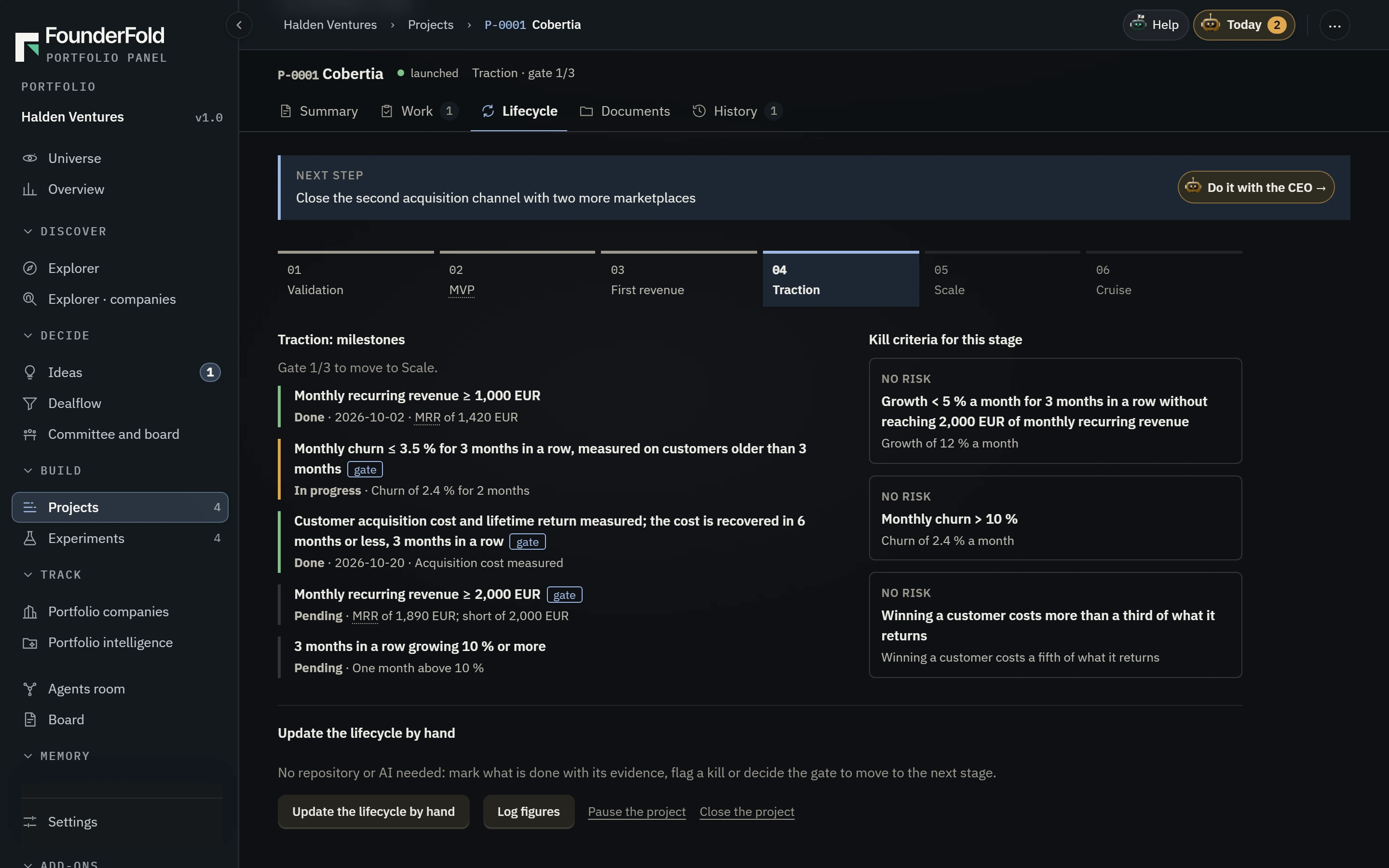
    A milestone is done when it has its evidence, and the gate decision records who decided, when and why. Gates skipped earlier stay visible as gate debt.

  • No risk · Watch · Triggered

    Kill criteria you can measure

    Each stage carries dated conditions that force a stop. When one is triggered, a person decides whether to stop, pivot or keep going, and writes down why.

  • Key figures

    Record figures

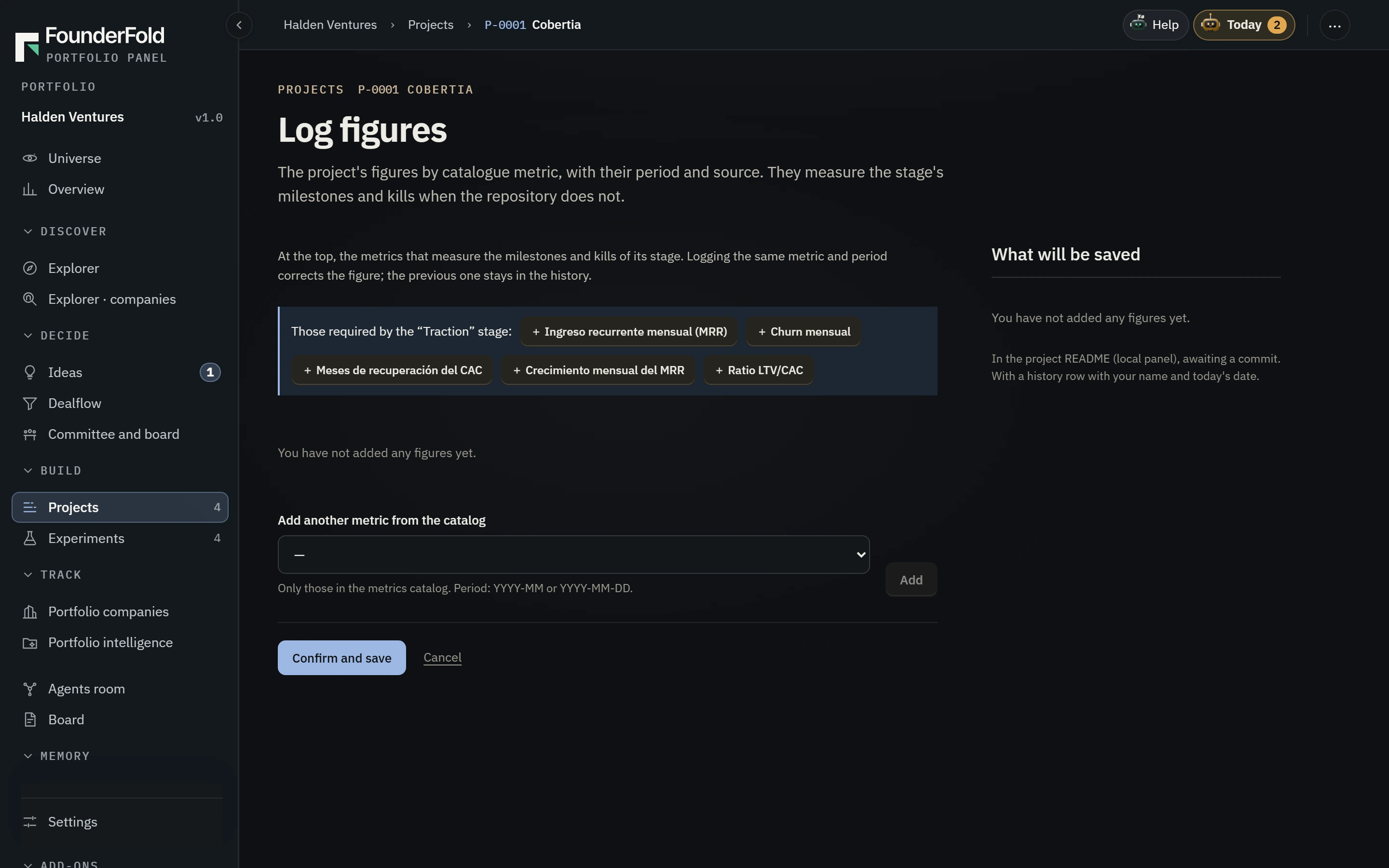
    The figures in a project’s record, such as customers, revenue or retention, measure its milestones and kill criteria, so its status is calculated instead of argued.

  • Retrospective

    Pause or close, with a retrospective

    Pausing or closing a project leaves a retrospective: what worked, what did not and the lessons, which stay in the portfolio for the next search.

  • Today

    Today, with the CEO

    The CEO lines up the next step by rules from your records: an overdue experiment, a kill criterion to review, a gate with a deadline. It prepares the close, and nothing is written until you confirm.

From chosen idea to the first paying customers

Illustrative data — Fictional company, ideas and figures, shown for illustration only.

The physiotherapy software from Discover, once it has been chosen.

  1. Open the Validation stage

    The project starts with three milestones: 20 clinic interviews, a price agreed with 5 clinics and a paid pilot signed.

  2. Write the kill criterion first

    If fewer than 5 of 20 clinics agree to a paid pilot by day 45, the project stops or pivots.

  3. Record the figures

    Each week the founder records interviews and pilots. On day 30 the criterion shows Watch, with 3 pilots so far.

  4. Decide the gate

    By day 42 there are 6 pilots. She records the evidence and decides the gate to the MVP stage, with the date and the reason.

Illustrative data — Fictional company, ideas and figures, shown for illustration only.

Today panel docked beside project P-0107: step 1 of 4, labeled “Overdue experiment”, says experiment E-0131 closed three days ago without a result, with the buttons “Yes, I have the result”, “Let the CEO prepare it” and “I need more time”.

Today, docked to the project you are looking at. The list is calculated by rules, without AI. Illustrative data.

How to write kill criteria you will actually apply

A kill criterion works when it is written while the team can still be objective, usually at the start of the stage. Four rules help.

  1. Use a figure you will record

    Customers, pilots, revenue or retention: a figure in the project’s record, so the criterion is measured, not argued. A metric with no data shows “not read” and is never replaced by a similar one.

  2. Give it a date

    “Fewer than 5 paid pilots by day 45” can be triggered; “if traction is weak” never will be. Every kill criterion carries its deadline.

  3. Agree what happens when it triggers

    Stopping, pivoting and keeping going are all possible answers. What matters is that a person decides and writes down why, and that the reason stays with the gate.

  4. Keep skipped gates in view

    If the team moves on before a gate is met, the gap stays visible as gate debt, so nobody forgets what was never proved.

The figures speak. A person decides.

Kill criteria and milestones are measured from the figures you record, but no gate is passed and no project is closed without a person’s decision, kept with its reason.

Who Build is for

Does it work for businesses that are not software?

Yes. Besides software, reference lifecycles cover a new line inside an existing company, the search for and purchase of a company, services, commerce and physical products, and a portfolio can set stages of its own. A code repository is optional.

What happens when a kill criterion is triggered?

It shows as Triggered, and a person decides whether to stop, pivot or keep going, with the reason written down. Nothing closes on its own.

Who can decide a gate?

The owners and editors of the portfolio; readers can only consult. Every gate decision keeps the person, the date and the reason.

Can a software project be updated from its code repository?

Yes. A software project with a repository can be brought up to date from it: FounderFold proposes what changed and you confirm what is saved.

Build fewer things, and finish the right ones.

Early access is by invitation.